Kırlangıç Evleri is a residential development in Bursa. The project focuses on managing residents, apartment vehicles and visitor movements in a parking area that uses the same physical gate for entry and exit. The solution brings field cameras and access hardware together with local decision software and management interfaces.
SMART PARKING · PLATE RECOGNITION
Kırlangıç Evleri
Two Hikvision cameras, Raspberry Pi 5, Hailo-8, plate recognition, barrier integration, web management and iOS/Android apps for a one-vehicle-per-apartment policy and visitor management.
PROJECT GALLERY
Project gallery — management panel, workshop and field installation
PROJECT STORY
Project overview and scope
Two Hikvision cameras, Raspberry Pi 5, Hailo-8, plate recognition, barrier integration, web management and iOS/Android apps for a one-vehicle-per-apartment policy and visitor management.
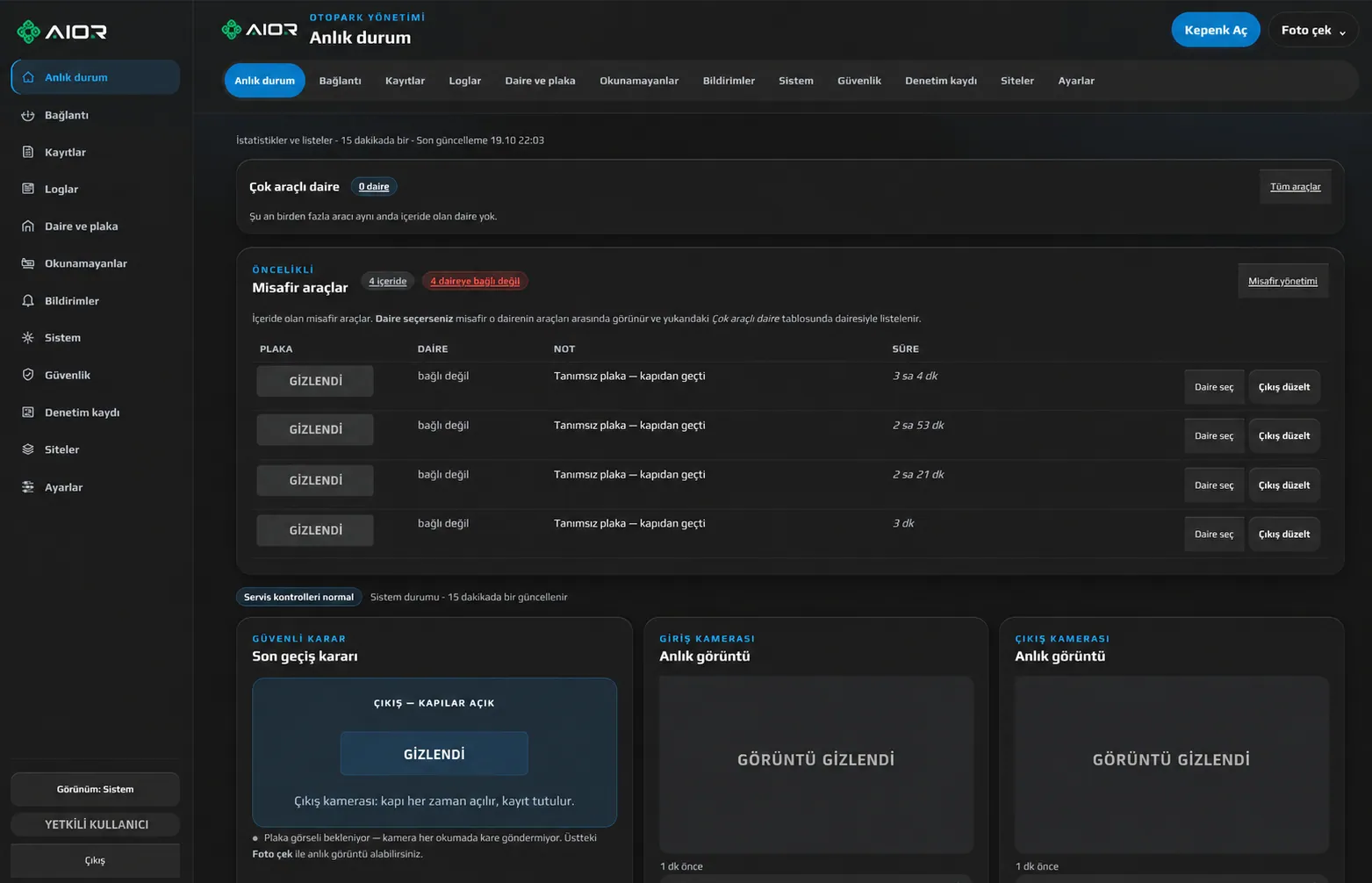
The completed project covers field assessment and hardware preparation, camera mounting components, two-direction imaging, plate recognition, local access decisions, integration with the existing barrier/shutter system, web management and iOS/Android client work. Apartment-to-plate relationships, visitor vehicles, movement records, unreadable images, system health and audit records are handled within a shared software structure. Workshop and field photographs show different preparation and installation stages; the first image is the management panel with personal fields concealed.
Two cameras facing opposite directions at a single gate produce different views of the same vehicle at different times. Raw plate observations needed to be distinguished from actual entry or exit, with stationary vehicles, pedestrians, repeated reads and uncertain-direction observations treated separately. Another core requirement was to keep access decisions independent of a mandatory internet or central-server round trip, while ensuring occupancy and visitor information reflected the quality of the underlying records.
Camera supports and mounting components were prepared in the workshop and integrated with the field hardware. Hikvision camera recognition capabilities were combined with local monitoring on Raspberry Pi and Hailo-assisted OCR. Both camera streams are monitored locally, with plate observations, vehicle motion, frame freshness and direction evidence used in passage assessment. The central server handles configuration, record collection, reporting and authorised management. Web and mobile clients use the same authenticated API structure, with roles and site scope enforced server-side. Manual request results are treated separately from the physical gate position. The project was completed as an integrated hardware, local-software and user-interface implementation.
One vehicle per apartment: registered plates and parking entitlement
The operating policy at Kırlangıç Evleri is one simultaneous parked vehicle per apartment. A household can own several vehicles and register multiple plates; registration does not grant all of them a simultaneous parking entitlement. Registered identities remain associated with the apartment when the vehicle being used changes, while assessment is based on which vehicles are currently inside.
The panel highlights multiple vehicles recorded inside for the same apartment as a policy violation. Resident vehicles and assigned visitors are considered together and deduplicated by plate. The overlap period and duration are tracked, allowing an operator to review the situation and correct a record for the relevant vehicle where necessary. This application layer provides management oversight through multi-vehicle detection, duration tracking and warning records.
Visitor vehicles and operator control
Visitor vehicles are managed separately from permanent apartment vehicles. Registering an authorised visitor, observing a vehicle that has passed without an apartment assignment and assigning an existing visitor are distinct operations. Observing or recording an unknown vehicle does not automatically grant entry authorisation.
Operators can view visitors inside, their assigned apartment, entry record and elapsed time. Apartment search supports the correct assignment, completed through an explicit save action. Identity and record-version checks prevent an outdated screen from overwriting newer state after another operator changes the vehicle or it exits and re-enters. An assigned visitor is included in the apartment’s simultaneous-vehicle assessment.
Two cameras at one physical gate
Two Hikvision iDS-2CD7A46G0/P-IZHS ANPR cameras are used in the installation. They observe the same gate from opposing directions, allowing approaching and departing views of a passage to be captured by different cameras. PoE/Ethernet connections provide imaging and communications, with adjustable brackets and mounting plates defining the physical installation.
Camera placement, approach area, focus, exposure and infrared illumination are considered together. Day and night conditions are evaluated for glare, oblique approach and frame freshness. Reads of the same vehicle by both cameras are not counted as two separate passages; direction and event matching are handled separately from repeated observations.
Local AI with Raspberry Pi 5 and Hailo-8
Raspberry Pi 5 provides field-side processing, while Hailo-8 accelerates compatible vision models. Both streams are monitored locally; the local OCR layer supplies additional recognition when native camera reads are incomplete. Image acquisition, plate-region detection, character recognition and event assessment are complementary stages.
Assessment uses more than the plate text: frame age, vehicle movement, observation source and evidence of entry/exit direction also matter. A repeated read of a stationary vehicle, pedestrian motion or uncertain-direction observation is not by itself converted into a new passage. Combining camera and local OCR results helps distinguish recognition from an actual movement record.
Barrier/shutter integration and network interruptions
Passage logic runs at the field camera/Pi layer. Camera allowlists, local assessment and the existing barrier/shutter controller form the access chain. The server is not a mandatory online decision point for every vehicle; it manages configuration, user authorisation, records and reporting.
During an internet interruption, local operation continues subject to power and local-network availability. Re-transmitting records must not turn a historical event into another gate-opening command. Authorised manual open actions are also recorded; acceptance of a command and measurement of the physical gate position are distinct facts.
Web panel: the operator’s daily workspace
Live status brings together multi-vehicle apartments, visitors, the latest passage decision, camera snapshots and service health. Connectivity, records, logs, apartments/plates, unreadable observations, notifications, system, security, audit, sites and settings are separated by purpose. Operators access daily information within their assigned site scope.
Current activity and periodic statistics are treated separately, with timestamps visible. Unreadable plates, incomplete direction evidence and cases requiring corrections are linked to inspectable records. Requesting a current camera frame is distinct from continuous video archiving; the camera areas present images requested for operations.
iOS application: Swift client and shared API
iOS application work is built around Swift source and the shared mobile API. Mobile workflows cover status, vehicle/apartment lists, visitors, records and daily operations permitted by the user’s role. Camera-frame requests, the latest decision and system information use the same data contract as the web interface.
Session and site permissions are enforced server-side. Manual commands explicitly handle pending requests and network errors, with safeguards against repeated taps producing unnecessary requests for the same physical action. Application source, API compatibility, signed device packages and store distribution are managed as separate release steps.
Android application: Kotlin and Compose interface
The Android client uses Kotlin/Compose and the same mobile API contract. Screens cover status, apartment/plate fields, visitor assignment, record details and authorised daily operations. Light/dark appearance, small-screen layouts, connectivity and request states form part of the mobile interface.
Keeping several plate slots for an apartment is not treated as permission to park several vehicles simultaneously. Visitor assignments and exit corrections retain the current vehicle identity. API role and site controls apply independently of the client screen; versioning and signing are tracked through the Android distribution process.
Warnings, audit and protection of personal information
Multi-vehicle and operational warnings are recorded for authorised management views. In-app notifications are distinct from operating-system background push delivery; notification channels and user permissions are considered together. Action and correction records help trace which underlying records were changed.
Plate and camera data is handled through authorised operational access. Real plates, user identity and camera images are concealed or blurred beyond readability in the management screenshots published here. Location/EXIF metadata has been removed from publication photos. The gallery consists of real project images showing different workshop and field-installation stages.
DELIVERABLES
Modules completed within the project
- 01One vehicle per apartment: distinguishing multiple registered plates from simultaneous entitlement and tracking second vehicles, assigned visitors and violation durations.
- 02Field and requirements assessment: evaluating entry/exit at a shared gate, camera coverage, the existing barrier/shutter and management requirements.
- 03Mechanical preparation and mounting: workshop preparation and field implementation of camera supports, adjustable brackets and mounting plates.
- 04Camera and network integration: two plate cameras observing opposing directions, PoE/Ethernet connections and mapping image sources to the application.
- 05Hardware: integration of two Hikvision iDS-2CD7A46G0/P-IZHS ANPR cameras, Raspberry Pi 5 and the Hailo-8 local AI layer.
- 06Raspberry Pi and Hailo: monitoring both streams in the field and providing local image-processing support when camera recognition is incomplete.
- 07Local passage decisions: assessing direction, vehicle movement and fresh-frame conditions through field logic independent of a mandatory central-server connection.
- 08Barrier/shutter integration: coordinating relay interfaces with the existing controller and the software flow for authorised manual commands.
- 09Apartment and vehicle management: multiple plate slots, vehicle lists and management views for multiple vehicles associated with one apartment.
- 10Visitor vehicles: viewing visitors, authorised apartment assignment and record-linked correction of exit status.
- 11Web management panel: live status, connectivity, records, logs, apartments and plates, unreadable observations, notifications, system, security, audit, sites and settings.
- 12iOS client: Swift application source and API integration for mobile status, records and authorised management workflows.
- 13Android client: Kotlin application work and the shared API contract for visitors, apartments, plates and daily operations.
- 14Authorisation and audit: role- and site-scoped access, action records and checks that prevent stale state from conflicting with newer records.
- 15Record quality and reporting: distinguishing raw plate observations from direction-confirmed movements and keeping uncertain and unreadable cases visible to operators.
- 16Operations and health: monitoring local services, connectivity, record transfer and freshness, with local operation and recovery handling for network interruptions.
- 17Project media preparation: optimised WebP versions of real workshop and field photographs, descriptive alternative text and desktop, mobile web and guest vehicle screenshots with personal fields concealed.
TECHNOLOGY STACK
Platforms and tools used
2 × Hikvision iDS-2CD7A46G0/P-IZHSRaspberry Pi 5Hailo-8ANPR / OCRPythonPHP / Web APIiOS / SwiftAndroid / Kotlin / ComposePoE / EthernetRelay / Barrier Integration
2
Opposing cameras
Edge AI
Local processing
Web + Mobil
Management channels
2026
Completed project
Delivered scope and continuity
The implementation combining cameras, local plate processing, access hardware and management software for Kırlangıç Evleri parking was completed. The web panel brings together live status, apartment and plate management, visitors, records, unreadable observations, system health and audit views. iOS and Android client and API work forms part of the project; store releases follow their own distribution and signing processes. Photographs are real project material; publication copies conceal plates and camera images and omit location/EXIF metadata.